

Board Performance · 2025
In this section14 topics
- Compliance Monitoring — Overview2 items
- Prevention of Conflicts of Interest3 items
- Prevention of the Use of Inside Information3 items
- Anti-Corruption4 items
- Whistleblowing4 items
- Selection of Directors & Chief Executives5 items
- Selection of Independent Directors2 items
- Evaluation of Board & Subcommittee Performance3 items
- Subcommittees1 item
- Meeting Attendance & Remuneration3 items
- Supervision of Subsidiaries & Associated Companies5 items
- Board Duty Performance — Overview1 item
- Audit Committee Duty Performance1 item
- Executive Committee Duty Performance1 item
Compliance Monitoring — Overview
Compliance Monitoring — Introduction
The Company recognizes that strong corporate governance is crucial for enhancing operational effectiveness and driving sustainable growth. To guide the management and oversight of the Company in creating long-term value, the Company has established a corporate governance policy that aligns with the Corporate Governance Code for Listed Companies 2017, as issued by the Securities and Exchange Commission (SEC).
The Company will continue to monitor adherence to these corporate governance practices. To reinforce this commitment, each year, all board members, executives, and employees are required to sign an acknowledgment of the Company’s business practices and Code of Conduct. Compliance will be tracked across the following key areas:
Monitoring of Compliance with Other CG Policies & Guidelines
No incidents related to corruption, the solicitation or offering of benefits to government officials, insider trading, or conflicts of interest were identified during the year.
Prevention of Conflicts of Interest
Has the Company Acted to Prevent Conflicts of Interest?
Yes
Operations in the Past Year
The Company operates on the principle that all business decisions must prioritize the best interests of the Company and its shareholders. Any actions that could create a conflict of interest should be avoided. Specifically, any transaction in which stakeholders or related parties stand to gain or lose, directly or indirectly, from the Company’s actions must be disclosed. Individuals with a direct or indirect interest in such transactions are required to inform the Company of their relationship or interest and must refrain from participating in the decision-making process or approving such transactions.
The Company has designated the Company secretary to monitor the disclosure of information regarding stakeholders associated with directors and executives. Additionally, the finance and accounting department is tasked with reporting intercompany transactions to the Audit Committee for review on a quarterly basis.
In 2025, the Company monitored and implemented measures to govern and prevent conflicts of interest as follows:
All directors and executives declared their interests and/or those of their related parties in accordance with the criteria prescribed by the Board of Directors.
The Company conducted connected transactions with transparency and in compliance with the principles approved by the Board of Directors, applying arm’s length terms comparable to those with external parties and prioritizing the Company’s best interests. Persons with vested interests in such transactions were not involved in the approval process, and such transactions were reported to the Audit Committee on a quarterly basis. For transactions not conducted under normal commercial terms and which may give rise to conflicts of interest, they were subject to review and opinion by the Audit Committee prior to seeking approval from the Board of Directors or shareholders, depending on the transaction size. The Company strictly complied with relevant regulations and ensured full disclosure of material information.
Number of Conflict-of-Interest Cases
| Metric | Current Year | Previous Year | Two Years Ago |
|---|---|---|---|
| Total number of cases or issues related to conflicts of interest (cases) | 0 | 0 | 0 |
Prevention of the Use of Inside Information
Has the Company Acted to Prevent the Use of Inside Information?
Yes
Operations in the Past Year
The Company has a strict policy prohibiting its directors, executives, employees, and staff, as well as those of its subsidiary, from using any non-public information that could potentially affect the price or value of the Company’s securities (“insider information”) for personal gain or to benefit others, whether directly or indirectly, and regardless of whether compensation is received. This policy also prohibits the purchase or sale of securities or entering into forward contracts related to the Company’s securities based on insider information.
The Company provides annual training on the use of inside information for personal gain to directors, executives, employees, and relevant personnel of the Company and its subsidiary in order to reinforce understanding and ensure compliance with the Securities and Exchange Act.
In 2025, the Company monitored and enforced measures to prevent the misuse of inside information for personal gain as follows:
The Company arranged annual training on the use of inside information for directors, executives, employees, and relevant personnel of the Company and its subsidiaries, to reinforce understanding and ensure compliance with the Securities and Exchange Act.
The Company Secretary prepared a summary report on the Company’s securities holdings of directors and executives.
The Company ensured that executives, employees, and external parties involved in ongoing projects and/or in possession of non-public information exercise caution in handling material information and prevent the disclosure of such confidential information to unauthorized persons.
Number of Inside-Information Cases
| Metric | Current Year | Previous Year | Two Years Ago |
|---|---|---|---|
| Total number of cases or issues related to the use of inside information to seek benefits (cases) | 0 | 0 | 0 |
Anti-Corruption
Has the Company Acted on Anti-Corruption?
Yes
Operations in the Past Year
The Company recognizes the critical importance of fighting corruption and is fully committed to conducting its business with integrity, within a strong framework of corporate governance. It adheres to the principles of good governance, ethics, and business conduct, while taking full responsibility for its impact on society, the environment, and all stakeholders. The Company’s business operations are conducted with transparency, fairness, and accountability, with a firm commitment to preventing corruption in all business activities. The Company also ensures that decisions and actions that may carry corruption risks are thoroughly assessed and executed with due diligence. Directors, executives, and employees of the Company and its subsidiary are strictly prohibited from engaging in, participating in, or tolerating any form of corruption—whether direct or indirect—for the benefit of the organization, themselves, their families, friends, acquaintances, or any business interest. This applies to all business operations, both domestic and international, and to all relevant departments within the Company and its subsidiary.
In addition, the Company will regularly review compliance with this anti-corruption policy to ensure its effectiveness and alignment with changing business practices, regulations, and legal requirements. Any actions that support, assist, or cooperate in corrupt activities will be subject to disciplinary measures in accordance with the Company’s internal regulations.
Details of Anti-Corruption Operations
The Company communicated its anti-corruption policy and related guidelines both internally and externally to ensure that all relevant stakeholders are aware of its intent and commitment to combating all forms of corruption.
The Company incorporated anti-corruption content into the orientation program for new employees to provide knowledge, raise awareness, and foster an organizational culture and values that oppose corruption.
The Company displayed public notices to promote whistleblowing channels for reporting suspected fraud, misconduct, improper behavior, as well as any concerns arising from work.
The Company also announced its intention to join the Thai Private Sector Collective Action Against Corruption (CAC) in February 2026. Currently, the Company is in the process of preparing the self-assessment documentation to apply for CAC certification.
Form of Anti-Corruption Operations
| Operation |
|---|
| The participation in anti-corruption projects |
| Communication and training for employees on anti-corruption policy and guidelines |
| Review of appropriateness in anti-corruption |
| The monitoring of the evaluation of compliance with the anti- corruption policy |
| Review of the completeness and adequacy of the process by the Audit Committee or auditor |
Number of Corruption Cases
| Metric | Current Year | Previous Year | Two Years Ago |
|---|---|---|---|
| Total number of cases or issues related to corruption (cases) | 0 | 0 | 0 |
Whistleblowing
Has the Company Implemented Whistleblowing Procedures?
Yes
Operations in the Past Year
The Company has implemented a whistleblowing system that provides employees and stakeholders, both internal and external, with the opportunity to report any misconduct or violations. This system is designed to protect and ensure fairness for employees who disclose information or provide tips related to corruption, legal violations, breaches of regulations, business conduct standards, or the Company’s code of ethics. In addition, the Company has established clear protection measures for whistleblowers, outlining the channels, procedures, and steps for reporting, as well as safeguarding those who report misconduct during the investigation process. The Company provides the following channels for submitting complaints:
Complaints can be sent to the Chairman of the Audit Committee, Audit Committee Members, or the InternalAudit Department at whistleblower@neo-corporate.com.
Complaints can be sent to the following address:
Chairman of the Audit Committee / Audit Committee Members
NEO Corporate Public Company Limited
888 Sukhumvit Soi 54, Phra Khanong Tai, Phra Khanong District, Bangkok 10260, Thailand.
During 2025, the Company received two complaints through its whistleblowing channels: one related to an employee and one concerning alleged misconduct in the performance of duties. After reviewing the sufficiency and clarity of the evidence, no wrongdoing was found in either case.
Number of Whistleblowing Cases
| Metric | Current Year | Previous Year | Two Years Ago |
|---|---|---|---|
| Total number of cases or issues received through whistleblowing channels (cases) | 2 | 0 | 0 |
Details of Whistleblowing Cases
| Status | Period Type | Start of Period | End of Period | Details of the Case or Issue | Investigation Results | Corrective Actions | Case or Issue |
|---|---|---|---|---|---|---|---|
| Incident no longer subject to action | month/year Range | 2025-07 | 2025-07 | Complaints regarding misconduct in the performance of duties. | After considering the sufficiency and clarity of the evidence, no wrongdoing was found. | Upon receiving the complaint, the responsible party conducted a preliminary review, verification, and fact-finding process, including inviting the relevant parties to provide information for the investigation. The matter was then presented to the Audit Committee for consideration and comments. However, the evidence and facts supporting the complaint were found to be insufficient. | 3201 · Other name: Misconduct in the performance of duties · Description: Other |
| Incident no longer subject to action | Within (month/year) | 2025-10 | 2025-10 | Complaints regarding employees’ use of illegal drugs. | After considering the sufficiency and clarity of the evidence, no wrongdoing was found. | The Company conducted a random drug test on the employee concerned and carried out an investigation by examining relevant physical evidence, including the workplace, personal belongings, and the employee’s behavior. The review found no irregularities, and no illegal substances were detected in the employee’s body. Currently, the Company conducts unannounced random drug testing for certain employees on a quarterly basis. | 3201 · Other name: Usage of illegal drugs · Description: Other |
Selection of Directors & Chief Executives
Are Directors Selected Through the Nomination Committee?
Yes
Are Chief Executives Selected Through the Nomination Committee?
Yes
Number of Directors from Major Shareholders
0
Rights of Minority Shareholders on Director Appointment
The Company recognizes and places importance on protecting the rights of shareholders. To ensure that shareholders receive basic rights equally and in order to comply with the principles of good corporate governance. The Company provides an opportunity for minority shareholders to nominate persons with suitable qualifications to be considered for selection as directors of the Company in advance, subject to the criteria and conditions as determined by the Company and announced on the Company’s website.
Method of Director Appointment
| Method |
|---|
| Method whereby each director requires approval votes more than half of the votes of attending shareholders with voting rights |
Selection of Independent Directors
Criteria for Selecting Independent Directors
Independent Director Selection Criteria and Process
In the nomination of directors, the Nomination and Remuneration Committee is responsible for establishing nomination policies and screening qualified candidates for directorship. Candidates may be sourced from the Director Pool, professional search firms, or through the Human Resources function, among others. The shortlisted candidates will then be proposed to the Board of Directors and/or the shareholders’ meeting for consideration and appointment. The qualifications of nominated candidates must comply with the relevant charters and must not be contrary to the Company’s Articles of Association, applicable regulations or laws, as well as the Company’s Corporate Governance Policy.
The Company has established a policy to appoint independent directors comprising no less than one-third of the total board, with a minimum of three independent directors. As of December 31, 2025, the Board of Directors consists of eight members, four of whom are independent directors, fulfilling the one-third requirement. All the four independent directors meet the qualifications stipulated by law and relevant regulations.
Did Any Independent Director Have a Business or Professional Relationship?
No
Evaluation of Board & Subcommittee Performance
Criteria for Evaluating Board Performance
Evaluation of the Performance of the Board of Directors and Subcommittees
The Board of Directors has implemented a regular performance evaluation for both the Board and its subcommittees, conducted on a collective and individual basis. This evaluation is carried out at least once a year to assess the effectiveness and performance of the Board in fulfilling its duties. The evaluation is divided into two main sections: one for the Board as a whole, with six key criteria, and one for individual directors, with three key criteria. This process aligns with the guidelines set by the Stock Exchange of Thailand, and includes the following:
Collective Basis | Individual Basis |
Structure and qualifications of the Board of Directors | Structure and qualifications of the individual director |
Roles, responsibilities, and duties of the Board | Participation in board meetings |
Board meetings and discussions | Roles, responsibilities, and duties of the individual director |
Performance of the Board members | |
Relationship and communication with management | |
Personal development of directors and development of executives |
Each is evaluated based on specific criteria, with scores assigned as a percentage (%) of the total points possible for each category, as detailed below:
Performance Results | Performance Evaluation Result By Committee (%) | Performance Evaluation Result By Individual (%) |
Excellent | 90% - 100% | 90% - 100% |
Very Good | 80% - 89% | 80% - 89% |
Good | 70% - 79% | 70% - 79% |
Satisfactory | 60% - 69% | 60% - 69% |
Needs Improvement | 0% – 59% | 0% – 59% |
Evaluation of Board Performance in the Past Year
The process of performance assessment is that the Company Secretary and the secretary of the subsidiaries committees are in charge of distributing the annual assessment form together to all directors for evaluation at the end of each year and preparing a summary of the results of assessment report to report to the Board of Directors for acknowledgement. The performance evaluation results of the Board of Directors and the Sub-committees can be summarized as follows:
Evaluation Results
| Evaluated Body | Group — Carried Out? | Group — Grade / Average Score | Group — Grade / Full Score | Individual (Self-Assessment) — Carried Out? | Individual (Self-Assessment) — Grade / Average Score | Individual (Self-Assessment) — Grade / Full Score | Cross (Assessing Other Directors) — Carried Out? |
|---|---|---|---|---|---|---|---|
| Board Of Director | Y | 98.15 | 100 | Y | 99.62 | 100 | N |
| Audit Committee | Y | 99.54 | 100 | Y | 99.24 | 100 | N |
| Executive Committee | Y | 95.78 | 100 | Y | 92.21 | 100 | N |
| Other Subcommittee | Y | 97.06 | 100 | Y | 98.86 | 100 | N |
Subcommittees
Subcommittees
| Results of the Subcommittee's Duty Performance |
|---|
The performance of the Nomination and Remuneration Committee for 2025 can be summarized as follows:
The Nomination and Remuneration Committee has performed its duties independently and in accordance with the principles of good corporate governance, ensuring that the nomination and remuneration processes are transparent and provide confidence to shareholders and all stakeholders. |
The performance of the Sustainability Committee for 2025 can be summarized as follows:
|
Meeting Attendance & Remuneration
Justification for Directors' Non-Attendance
Mr. Suthidej Thakolsri and Miss Nitchamon Thakolsri were unable to attend the meeting due to other commitments.
Types of Remuneration of the Board of Directors
Monetary Remuneration
During the Annual General Meeting of Shareholders for 2025, held on April 23, 2025, the shareholders approved the remuneration for the Board of Directors and its subcommittees for 2025. The approved remuneration consists of a monthly allowance and meeting attendance fees, as outlined below:
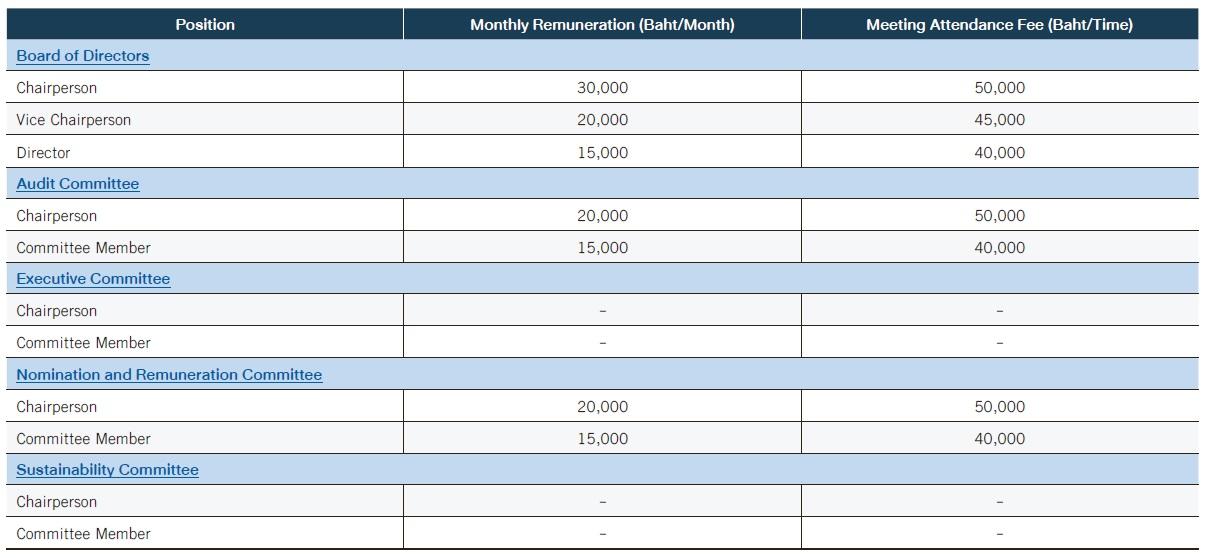
Note :
For meeting attendance fees, if multiple meetings are held in a given month due to necessity, the Company will pay the attendance fee only once for that month.
The meeting attendance fees and monthly remuneration for 2025 will be effective from the date of approval by the shareholders’ meeting, with no retroactive payments for any differences.
In the event that a director resigns during the month, the Company will consider paying remuneration on a pro-rata basis according to the actual period during which such director served in office.
If a director holds positions on more than one committee, the Company will consider paying meeting allowances and monthly remuneration according to the number of positions held by such director.
The company maintains a Director and Officer Liability Insurance (D&O) policy with a coverage limit of 200 million baht.
The Company does not provide any other forms of remuneration (whether monetary or non-monetary).
Remuneration or Benefits Payable to the Board
| Metric | Amount (Baht) |
|---|---|
| Remunerations or benefits pending payment to the board of directors over the past year (baht) | 0 |
Supervision of Subsidiaries & Associated Companies
Does the Company Have Subsidiaries or Associated Companies?
Yes
Is There a Mechanism for Overseeing Subsidiaries and Associated Companies?
Yes
Mechanism for Overseeing Management of Subsidiaries
The Company has established a governance policy for overseeing the operations of its subsidiary and/or associates. This policy aims to implement both direct and indirect measures and mechanisms that enable the Company to effectively monitor and manage the activities of these entities. The goal is to ensure that the subsidiary and associates comply with the Company’s policies and relevant laws, as well as adhere to the regulations, announcements, and guidelines set by the Capital Market Supervisory Board, the Securities and Exchange Commission (SEC), and the Stock Exchange of Thailand (SET). This is done to protect and preserve the Company’s investment interests in its subsidiary and/or associates. The governance framework operates as follows:
The Company will appoint representatives to serve as directors in its subsidiary and/or associates based on its shareholding proportion in each company and/ or mutual agreements in the case of associates. These representatives must possess the necessary qualifications and experience relevant to the business and must not have any conflicts of interest with the operations of the subsidiary and/or associates. The appointed representatives are responsible for managing the subsidiaries and/or associates in accordance with the Company’s policies and applicable laws.
If a transaction or action of the subsidiary qualifies as an acquisition or disposal of assets and/or a related party transaction under relevant laws and securities regulations, which would require the Company to seek approval from its Board of Directors and/or the shareholders’ meeting (as applicable), or from relevant authorities prior to completing the transaction, the subsidiary may proceed only after obtaining the necessary approval from the Board of Directors and/or shareholders’ meeting and/or relevant authorities, as required.
Additionally, if a transaction or event involving the subsidiary triggers the Company’s obligation to disclose information to the Stock Exchange of Thailand as per applicable regulations, the representative director of the subsidiary must immediately notify the Company’s management as soon as they are aware that the subsidiary intends to engage in the transaction or that such an event has occurred.
The Board of Directors and management of each subsidiary and/or associate will have clearly defined authority, duties, and responsibilities in accordance with applicable laws. This includes the obligation to disclose financial information and operational performance to the Company. In this regard, relevant announcements and regulations set forth by the Capital Market Supervisory Board and the Securities and Exchange Commission (SEC) may apply mutatis mutandis. Additionally, they are required to disclose their personal interests, as well as those of related parties, to the Company’s Board of Directors. This includes informing the Board of any relationships and transactions with the Company, the subsidiary, and/ or associates that may give rise to potential conflicts of interest. Furthermore, they must take proactive steps to avoid any transactions that could lead to such conflicts.
The Company will establish and implement necessary plans to ensure that its subsidiary and/or associates provide accurate and timely disclosures regarding their performance and financial position. The Company will take the necessary steps and closely monitor to ensure that subsidiary and/or associates implement adequate and effective information disclosure systems and internal controls to support the efficient management of their operations.
The Company will closely monitor the performance and operations of its subsidiary and/or associates, ensuring proper recording and maintenance of their financial data and accounts. It will also present analytical reports, along with recommendations or feedback, to the Company’s Board of Directors and the boards of the relevant subsidiary and/or associates. These insights will inform decisions on policy development or adjustments, with the goal of fostering the continuous growth and success of the subsidiary and/or associates.
Oversight Mechanisms
| Mechanism |
|---|
| Sending representatives to act as directors, executives or controlling persons in proportion to shareholdings |
| Disclosure of financial information and operating results |
| Other important transactions |
| Acquisition or disposal of assets |
| Internal control system of the subsidiary operating the core business is appropriate and sufficient in the subsidiary operating the core business |
Agreements Between the Company and Shareholders in Managing Subsidiaries
The Company does not have any Shareholding Agreements among major shareholders that could affect its management.
Board Duty Performance — Overview
Board Duty Performance — Overall Description
The Board of Directors has performed its duties in accordance with the Board Charter, which is consistent with the Corporate Governance Code for Listed Companies 2017 (CG Code) issued by the Securities and Exchange Commission (“SEC”). The Board also monitors and oversees operations to ensure compliance with the Company’s good corporate governance policy, code of business conduct, and other related policies
In 2025, the Company held a total of six Board of Directors’ meetings. The meeting schedule was set in advance for the entire year, and the Company provided supporting documents to the Board at least seven days prior to each meeting. During 2025, the Board of Directors performed its duties covering the following matters:
Approve the annual budget and acknowledge the company’s business strategies to ensure that the organization can achieve sustainable growth and fulfill its corporate vision. Management is tasked with reporting on the implementation of these strategies at every Board of Directors’ meeting.
Approved various policies to support compliance with the Corporate Governance and Code of Business Conduct, and monitored policy implementation through management reports.
Approved investments in various projects to expand the business capabilities of Neo Corporate Group.
Approved the annual and quarterly financial statements.
Approved the Company’s organizational structure.
Approved the salary increase rates for the Chief Executive Officer, executives, and employees, as well as the annual bonus payment rates.
Approved the schedule of important Company meetings.
Reviewed key annual criteria and policies, including the charters of the Board of Directors and its sub-committees.
Monitored the review of the adequacy and appropriateness of the Company’s risk management and internal control systems.
Acknowledged the Company’s annual and quarterly operating results and provided useful recommendations for the Company’s operations.
Acknowledged the progress of investment projects undertaken by Neo Corporate Group.
Oversaw management to ensure operations were conducted in accordance with the approved policies, strategies, and business plans.
Audit Committee Duty Performance
Results of the Audit Committee's Duty Performance in the Past Year
The performance of the Audit Committee for 2025 can be summarized as follows:
The Audit Committee has reviewed the annual financial statements of 2024 and the quarterly financial statements of 2025 of the Company and its subsidiary in consultation with both the responsible management and external auditors, to assess the accuracy and completeness of the financial statements, as well as the adequacy of their disclosures. This review also included observations and innovations aimed at improving the audit process. The Audit Committee agrees with the external auditors’ opinion that the financial statements of the Company and its subsidiary have been properly presented in accordance with applicable financial reporting standards, are reliable, and provide useful information to the financial statement users.
The Audit Committee considered the internal audit report to ensure the Company has an adequate, appropriate, and effective internal control system. The evaluation was conducted in collaboration with the internal auditors, and the Audit Committee provided management with recommendations for improvements to the system within specified timelines. Based on this assessment, the Audit Committee is of the opinion that the Company’s internal control system is sufficiently robust, with no material deficiencies that could impact the financial statements.
The Audit Committee reviewed and approved the annual internal audit plan, which has been updated to improve its effectiveness and ensure it covers all key operations and departments. The Audit Committee also reviewed the internal audit reports concerning the operations of the Company and its subsidiary, ensuring that there is a comprehensive process in place for planning, reporting, and tracking the implementation of the internal auditors’ recommendations.
The Audit Committee reviewed transactions between related parties, including any transactions that might involve potential conflicts of interest, and assessed the adequacy of their disclosure in accordance with the rules and regulations of the Stock Exchange of Thailand and the Securities and Exchange Commission (SEC).
The Audit Committee carefully reviewed and recommended the appointment of an internal auditor and approved the annual budget for internal audit services for 2025. The selection was based on a thorough evaluation of the candidate’s performance, qualifications, expertise, and experience. The Committee proposed the appointment of KPMG Phoomchai Business Advisory Co., Ltd., an independent firm specializing in internal control audits, to serve as the Company’s internal auditor. Additionally, the Committee recommended approving the internal audit budget for 2025.
The Audit Committee considered and approved the appointment of an external auditor and the associated audit fees for 2024, based on the auditor’s performance, qualifications, experience, and expertise. The Committee proposed the appointment of EY Office Co., Ltd., as the Company’s external auditor and recommended approving the audit fees for 2025.
The Audit Committee reviewed and ensured that the Company and its subsidiary are fully compliant with all relevant accounting standards, legal requirements, and regulations issued by the Stock Exchange of Thailand (SET), as well as any other applicable laws governing the business. The Committee confirmed that all necessary disclosures have been made, and that the Company’s financial practices align with sound corporate governance principles.
The Audit Committee reviewed the adequacy of the Company’s risk management processes and conducted audits based on identified risks.
To review the Company’s key policies.
The Audit Committee has diligently and cautiously carried out its duties, ensuring sufficient independence in its oversight. The Committee is of the view that the Company’s financial and operational reporting is accurate, reliable, and in full compliance with relevant standards. The Company maintains an effective internal control system, internal audit procedures, and proper disclosure of related-party transactions. Additionally, the Committee has affirmed that the Company’s operations align with established corporate governance practices. The Company has also demonstrated a commitment to continuously enhancing its operational systems to improve quality and adapt to the evolving business environment.
Executive Committee Duty Performance
Results of the Executive Committee's Duty Performance in the Past Year
The performance of the Executive Committee for 2024 can be summarized as follows:
The Executive Committee is responsible for formulating and establishing the Company’s policies, strategic direction, business plans, budgets, organizational structure, and management authority. These plans and structures are presented to the Board of Directors for approval. Upon approval, the Executive Committee oversees the execution of these plans, ensuring that they are implemented effectively and efficiently. Additionally, the committee monitors and evaluates the performance to ensure optimal outcomes in line with the Company’s goals.
The Executive Committee is tasked with reviewing, evaluating, and ensuring that all departments and functions operate in alignment with the Company’s policies, strategies, business plans, and budgets. This includes ensuring that operations are executed efficiently and appropriately, considering the evolving business environment.
The Executive Committee evaluates and approves contracts and/or transactions related to the normal business operations of the Company (for example, buying, selling, investing, or entering into joint ventures with third parties for transactions in the ordinary course of business, aimed at supporting the Company’s operational objectives and advancing its strategic goals), provided these fall within the limits established in the Authority Limits Manual or as determined by the Board of Directors.
The Executive Committee diligently performs its duties, ensuring that the operations of the Company and its subsidiary are in line with the established business direction and strategies. It consistently strives for high operational efficiency and compliance with good corporate governance practices. This approach allows the Company and its subsidiaries to successfully meet their objectives, policies, and plans.